Last updated November 25, 2026




Free roof inspection with deck photos before we talk money - GAF and Owens Corning certified installation
Roofing Warning Signs: An Everett Homeowner’s Reference Guide
Most homeowners picture roof failure as an event: a shingle blows off in a windstorm, water stains the ceiling, someone calls a roofer. In Everett, it rarely works that way. What actually takes roofs down here is a slow sequence. Moisture gets into a small seam or a nail line during the wet months, never fully dries through the shoulder seasons, and works at the decking a little more each year. By the time a roof deck sags, that sequence has usually been running for years and has thrown off several warnings that were easy to dismiss. This guide sorts those warnings by how fast you should act, and explains what each one is actually telling you.
Quick Answer
Roofing warning signs in Everett fall into three urgency tiers: act now (days) for sagging, daylight through the deck, or active water intrusion; book an inspection within 90 days for granule buildup in gutters, cracked flashing sealant, rust streaking, or interior staining; and monitor across seasons for moss regrowth, minor shingle cupping, and attic condensation. Moss, attic staining patterns, and flashing wear are the three signals that most reliably predict roof failure before anything is visible from the ground.
Styles & brands we work with
- Architectural shingles
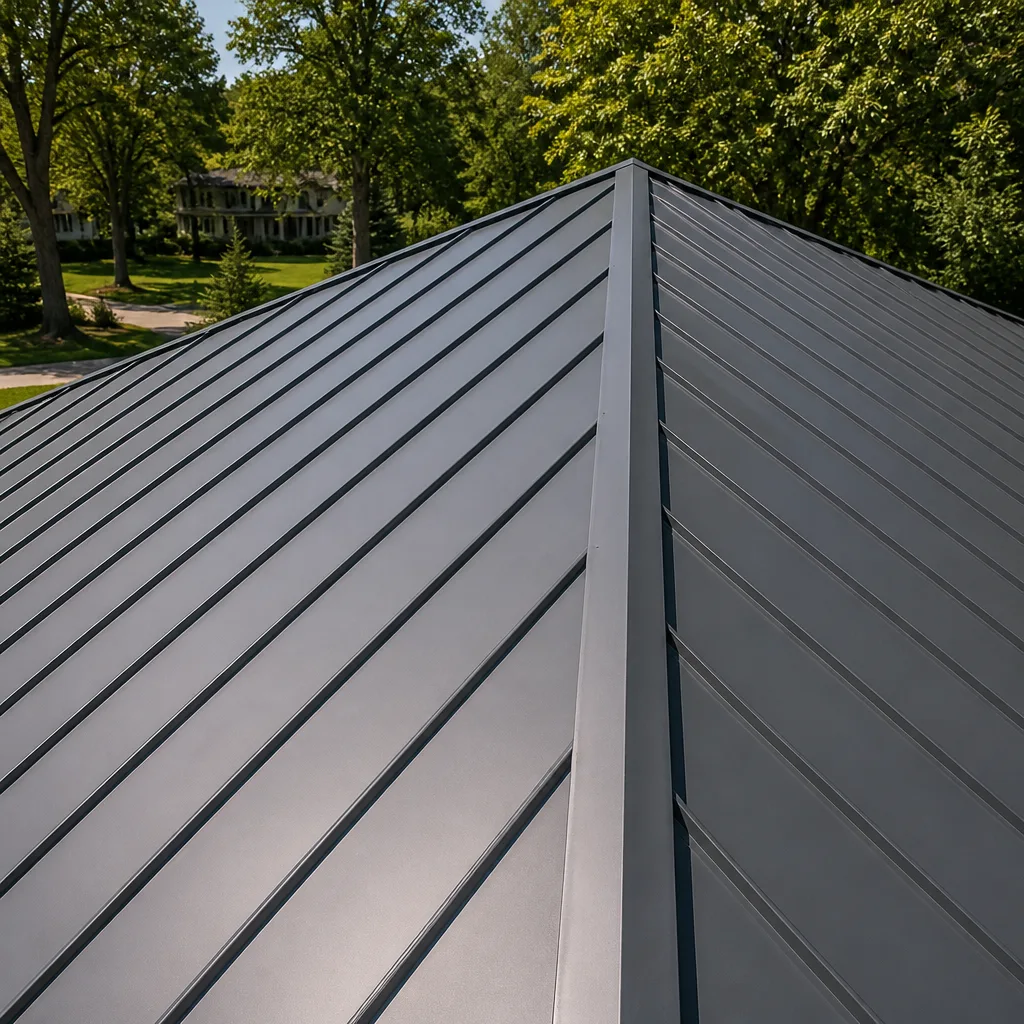
- Metal roofing
- Tile roofing
- GAF
- Owens Corning
- Flat & low-slope
Table of Contents
- The Three-Tier System: How Urgent Is That Sign?
- Moss and Lichen as a Diagnostic Tool
- Attic Warning Signs That Show Up Before Exterior Damage
- Flashing Failure Indicators in Everett’s Rainfall
- Granule Loss: The Downspout Collection Test
- Shingle, Tile, and Metal: How Warning Signs Differ by Material
- What to Check Each Season in Everett
- Repair or Replace? Reading the Signs Together
The Three-Tier System: How Urgent Is That Sign?
Not every warning sign means the same thing, and treating them all as equally urgent is how homeowners end up either panicking over nothing or waiting three years on something serious. We sort what we find into three tiers. The tier tells you how fast to move, not how much the fix will cost.
Tier 1: Call a professional within days.
- A visible sag in the roof plane or ridge line.
- Daylight showing through the roof boards from inside the attic.
- Active dripping, a bulging ceiling, or water running down an interior wall.
- Soft spots in the decking you can feel from the attic.
- Any sign of water reaching an electrical fixture.
Tier 1 signs mean moisture has already done structural work. A sagging deck doesn’t appear overnight; it’s the visible end of a long moisture sequence, and it means the framing itself needs to be looked at, not just the surface. Don’t walk a sagging roof, and don’t put a ladder against a compromised eave.
Tier 2: Book an inspection within 90 days.
- Heavy granule accumulation where downspouts discharge.
- Flashing sealant that’s cracked, peeled, or pulling away.
- Rust streaks below vents, chimney surrounds, or pipe boots.
- Brown or copper-colored stains on attic sheathing or rafters.
- Curling, clawing, or cupping shingle edges across a section of roof.
These signs are developing problems, not failures. Ninety days gives you time to get on a schedule and budget, and it keeps a small flashing repair from becoming a decking replacement.
Tier 3: Monitor across seasons.
- Moss returning a season or two after a cleaning.
- Slight granule loss with no other symptoms.
- Attic condensation on nails or sheathing in cold weather.
- Minor shingle discoloration on north-facing slopes.
Tier 3 signs aren’t nothing. They’re the early indicators that tell you how much life the roof has left, and it helps to write down what you see and when. A pattern across two or three seasons is more informative than any single observation.
Moss and Lichen as a Diagnostic Tool
Homeowners usually treat moss as a cosmetic problem: ugly, a little embarrassing from the street, maybe worth a cleaning. In Everett, moss is better understood as a gauge. It’s telling you about the roof’s surface condition, and its stage tells you something about how much life the shingles have left.
Moss needs moisture, shade, and a textured surface to take hold. It grows fastest on north-facing slopes, under tree canopy, and anywhere the roof stays damp longest after rain. In our climate, that’s most of the roof for a good part of the year, which is why moss is close to universal on older asphalt roofs here rather than an occasional nuisance.
Here’s the diagnostic part. Moss anchors itself in the granular surface of a shingle. As granules loosen, that surface gets rougher and holds more moisture, and the moss spreads. So the extent of moss coverage is partly a readout of how much granule loss the shingles have already experienced. A roof with scattered moss on one shaded slope is in an early stage. A roof where moss has formed a continuous carpet across multiple slopes is telling you the surface is far along in its wear.
Lichen, the flatter gray-green crust that clings in circular patches, is a related signal. It’s harder to remove than moss without damaging the shingle surface, and its presence over a wide area usually means the roof has been holding moisture for a long stretch.
What moss is not is proof the roof needs replacing. A young roof with a shade problem can grow moss on sound shingles. The read works the other way: moss plus other signs (granule loss, curling, attic staining) points toward a roof in its later years. Moss alone points toward cleaning, trimming back overhanging branches, and looking at what’s underneath. A licensed local professional can tell the difference between a moss problem and a wear problem, and it’s worth having that answered before you schedule a cleaning.
Attic Warning Signs That Show Up Before Exterior Damage
If you want to catch roof trouble before it’s visible from the ground, the attic is where to look first. Interior signs show up earlier than exterior ones because water has to pass through the deck before you’d ever see it outside, and by then the roof surface has usually been failing for a while. A flashlight and a few minutes in the attic tell you more about roof health than a walk around the driveway.
Staining patterns and what they mean. Water stains in an attic are a map. Where the stain sits tells you where the entry point is likely to be.
- Stains on the underside of roof sheathing, especially in bands running horizontally, usually point to water backing up or getting under shingles at a seam above.
- Stains running down rafters from the ridge area suggest ridge vent or ridge cap issues.
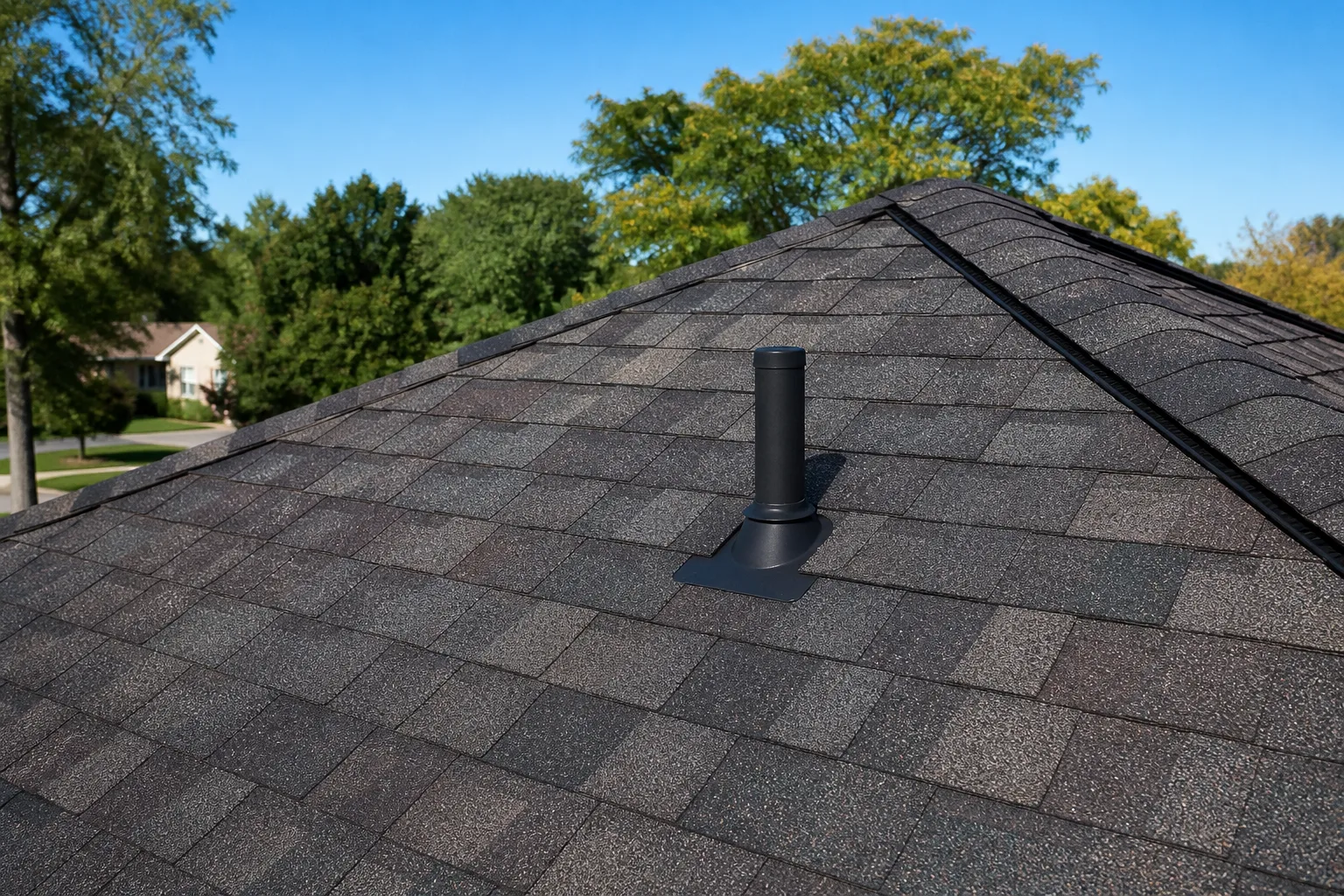
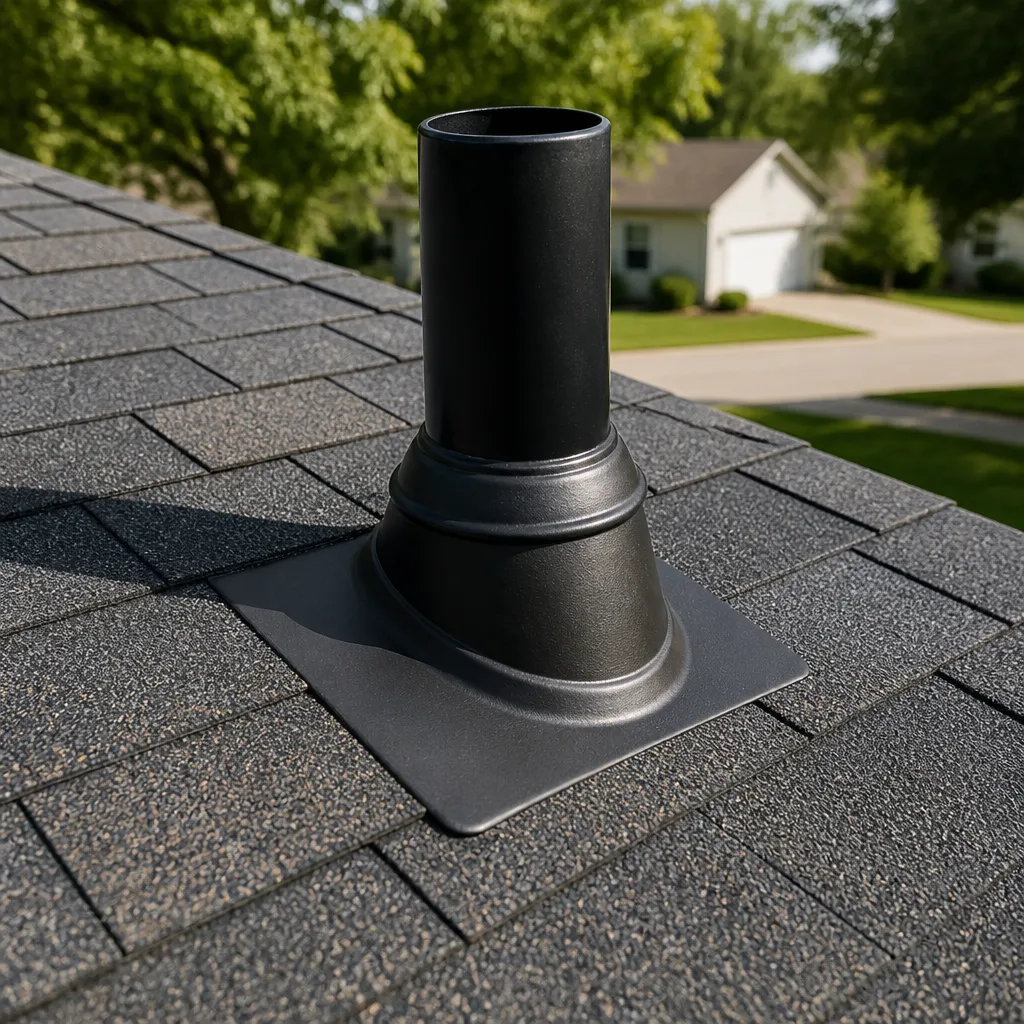
- Concentrated staining around a chimney, vent stack, or pipe boot almost always means flashing.
- Stains on the attic floor near the eaves can indicate ice damming or wind-driven rain getting under the eave.
Insulation compression. Insulation that looks matted, flattened, or wet along the outer edges of the attic floor is a sign moisture is coming in at the eave line. That’s common in Everett where gutters back up and water wicks inward along the roof deck. Compressed insulation holds less, and it also signals that the problem is ongoing rather than a one-time event.
Rafter moisture and condensation. If you see water beads on the nails poking through the roof deck, or frost on the sheathing in cold weather, the attic isn’t ventilating properly. Excess moisture in the attic doesn’t just threaten the roof structure; it also accelerates wear on the shingles from underneath by keeping the deck wet. Look for dark discoloration on the wood, which can be an early sign of rot.
Take photos when you inspect the attic. Comparing this season’s photos to last season’s is one of the most useful diagnostic habits a homeowner can build, and it’s the kind of evidence a roofing pro can read quickly during a free estimate.
Flashing Failure Indicators in Everett’s Rainfall
Flashing is the metal detailing around chimneys, vents, skylights, valleys, and walls, plus the sealant that keeps the joints tight. It’s the first thing to fail on most roofs, and in an area that gets as much rain as Everett, its condition reads like a timeline. The Pacific Northwest’s long wet season gives water the time and volume to find any gap, and the slow dry cycle means a small opening rarely gets a chance to seal itself before the next storm.
What to look for, from the ground or from a safe distance with binoculars:
Rust streaks. A rust-colored trail below a vent, chimney, or skylight usually means water has been running down a metal flashing component long enough to oxidize it. Streaks don’t always mean water is getting inside yet, but they mean the flashing is at or past the end of its working life.
Cracked or peeling sealant. Standard roof sealant is a maintenance item, not a permanent fix. Over several years in this climate, it hardens and cracks, especially around the chimney and along wall intersections. Cracking sealant is the most common path by which a small problem becomes a wet attic. It’s also one of the cheapest things to correct, which is why it’s a Tier 2 sign rather than a Tier 1.
Lifted or wavy flashing. Flashing should sit tight against the surface it’s protecting. If it’s pulled away, curled at the edge, or sitting proud of the roof plane, water can get behind it rather than over it. That can happen where nails have backed out or where a prior repair used nails in the wrong place.
Debris accumulation in valleys. Valleys are where water concentrates. When leaves and needles collect there, water backs up under the shingle edges and finds its way into the flashing beneath, then into the deck.
Any of these is worth having looked at before the rainy season is at full volume. A small flashing repair done early is a different scale of job than the decking repair it prevents. During a roof replacement, flashing gets rebuilt from scratch, which is part of why replacements are a chance to correct years of deferred detail work.
Granule Loss: The Downspout Collection Test
Asphalt shingles shed granules as they age. That’s normal, and some loss is expected from the day the roof is installed. The question isn’t whether granules are coming off, but whether the rate is normal or accelerated. Here’s a simple test any homeowner can run.
- Place a bucket or a clean cloth at the bottom of a downspout. Choose a downspout that drains a sizable roof area, and make sure the roof above it isn’t covered in moss you’d confuse for granules.
- Wait for a steady rain, or run a garden hose at the top of the roof plane. A 20- to 30-minute flow gives you a representative sample.
- Inspect what collected. Granules look like coarse sand or small dark specks. A few grains are normal. A visible layer of sand-like material covering the bottom of the bucket after a single storm suggests the shingles are shedding faster than they should.
- Repeat the test twice in different seasons. Compare the amounts. This is the part most homeowners skip, and it’s the part that matters most. A consistent amount over a wet season and a dry season is baseline. An increasing amount over time is a signal the shingles are near the end of their useful life.
- Check the gutters too. Granule buildup in the gutters, especially in the corners, is often more visible than what comes out of the downspout.
When is granule loss cosmetic, and when is it structural? Cosmetic loss is a light scattering with intact shingle surfaces underneath. You can see this by looking at the shingles up close: if the granular face is still consistent, the shingle is doing its job. Structural loss is where the granules are gone from significant patches, exposing the dark asphalt underneath. That asphalt is the layer that protects against UV and water. Once it’s exposed, the shingle’s remaining life shortens quickly, and you’ll see curling, cracking, and blown-off tabs follow.
A second test anyone can do: take a ladder and look at the shingle edges along a gutter (from the ground, or with a phone camera on a selfie stick). If the shingles look like they’ve lost their texture and the exposed asphalt is showing through, that’s structural. From there, the roof is running on borrowed time, and the downspout test is just confirming what you can already see.
This is where material choice becomes relevant. Some of the value-priced shingles on the market, including lines from IKO and Tamko, are solid performers but have different granule retention characteristics than premium lines from GAF or CertainTeed. If your roof is showing advanced granule loss, the question of what goes up next matters as much as the timing. More on that below.
Shingle, Tile, and Metal: How Warning Signs Differ by Material
The signs that matter most depend on what’s on your roof. Shingle, tile, and metal fail in different ways and on different timelines, and treating all three as if they fail alike leads homeowners to miss the warning signs specific to their own roof.
Asphalt shingles. The most common roof type in Everett, and the one with the shortest life. Warning signs are mostly surface-level: granule loss, curling at the edges, cupping across a section, and blistering on sun-facing slopes. Shingle roofs also take the most visible moss damage, and the attic staining and flashing problems covered earlier in this guide are most common on shingle roofs. Granule loss is the primary readout, which is why the downspout test matters most here.
Tile roofing. Tile roofs, including those from Boral, don’t wear through the tile itself. The tile is a durable fascia. What wears out is the underlayment beneath, which carries the actual waterproofing. Warning signs on a tile roof are therefore different: you’ll see lifted or slipped tiles, and you’ll see attic moisture or ceiling staining that points to an underlayment problem even though the tiles look fine. A tile roof that’s shedding tiles after a windstorm needs its underlayment checked as well, not just the visible tiles replaced. The corollary is that a tile roof can look great and still be near its underlayment’s end of life, which is why an inspection on a tile roof is about checking what’s under it, not just looking at it.
Metal roofing. Metal has the longest service life of the three, and its warning signs are slower-developing. What to watch for: loose or backed-out fasteners, sealant failure at penetrations and end laps, and staining at seams that suggests the fastening or the sealant is giving out. Metal roofs also show dents and dings from debris that are cosmetic rather than structural. Rust is the main structural concern, but where it occurs it’s usually at cut edges or penetration points, not across the panels.
If you’re weighing a shingle roofing replacement against tile or metal, the difference in warning signs follows from the material. A shingle roof tells you in years. A tile or metal roof tells you in decades, but it tells you less often and less loudly, which is one reason scheduled inspections matter more on the longer-life systems. Working with a contractor that installs all three, rather than one who only stocks shingles, means the recommendation you get isn’t shaped by what’s already on the truck.
What to Check Each Season in Everett
Everett’s wet season does most of the damage, and the dry months are when you have the best chance to catch what it left behind. A simple seasonal routine catches most warning signs early.
- In late summer or early fall, before the rains return: clean the gutters and valleys, check flashing sealant, and clear leaves and needles. Look at the downspout discharge for granule concentration. Clear any tree branches that have grown over the roof.
- After the first major fall storm: walk the perimeter and check for loose or missing shingles, pieces of flashing that have shifted, and anything new on the ground. This is a ground-level check only.
- Midwinter, from inside: with a flashlight, check the attic for new staining, condensation on nails and sheathing, and wet spots near the eaves. Don’t go up on the roof in wet conditions.
- In spring: check for moss regrowth and note how much came back over the winter. Re-run the downspout collection test. Check the attic again and compare to winter photos.
- In summer: look at the roof surface from the ground or with binoculars on a sunny day. Sun angles make curling, cupping, and granule wear most visible in the dry months.
Keep a simple log. Date, what you saw, where you saw it, what the weather had been. If you call for a free estimate, that log is one of the most useful things you can hand a roofing pro, because it shows the pattern rather than a snapshot.
Repair or Replace? Reading the Signs Together
One sign rarely settles the question. The useful reading comes from combining them: how many, how severe, and how fast they’re developing.
A repair is usually the right answer when:
- Signs are localized to one area, typically around flashing, a chimney, or a single valley.
- The shingles elsewhere are intact, granules are still present, and the roof is early in its life.
- The attic is dry and staining is absent or old and inactive.
A replacement is usually the right answer when:
- Granule loss is structural across multiple slopes.
- Curling or cupping appears across more than one slope.
- Attic staining is active and follows a broad pattern rather than a single point.
- Flashing failure has combined with decking damage.
- Repairs have become recurrent in the same spots.
In our experience, the most useful way to think about it is this: the sign that matters is how many systems are failing at once. A single flashing failure is a repair. A roof that’s losing granules, holding moss, and staining the attic is a set of failures that will recur even if the visible symptoms get patched. At that point, a roof replacement is often the more economical route, because it gets the whole assembly back to a known starting point instead of resetting one symptom at a time. A new roof installation on a home starting from the deck up follows the same logic, just with more freedom in material choice.
Common Mistakes to Avoid
- Treating moss as a cosmetic problem. Moss is a diagnostic, not just an eyesore. Cleaning it without looking at what’s underneath the growth can mean missing a shingle that’s already well into its wear cycle.
- Ignoring attic staining because the ceiling is still dry. Staining in the attic usually precedes ceiling stains by a significant margin. By the time water is showing in a living space, the deck has been getting wet for longer than most homeowners realize.
- Using sealant as a permanent fix. Sticking a bead of caulk over a cracked flashing joint stops water for a season or two at most. The underlying flashing detail still needs to be corrected.
- Walking the roof after a storm to check it yourself. Wet shingles are slippery, and a roof that’s already compromised is worse. Ground-level checks and phone-camera inspections cover most of what you need.
- Skipping the downspout test because it’s cold or rainy. The test is most useful during the wet season, and consistency is what makes it diagnostic. A single sample tells you less than two samples compared.
- Assuming a tile or metal roof is maintenance-free. These systems have long lives but still need their underlayment, fasteners, and sealant checked. A tile roof’s warning signs tend to show up in the attic, not the surface.
- Choosing a roofing contractor on price alone, without asking about materials. A contractor who only installs one product type will recommend that product regardless of what your home needs. Ask about the full slate of options, including the manufacturer lines the contractor installs.
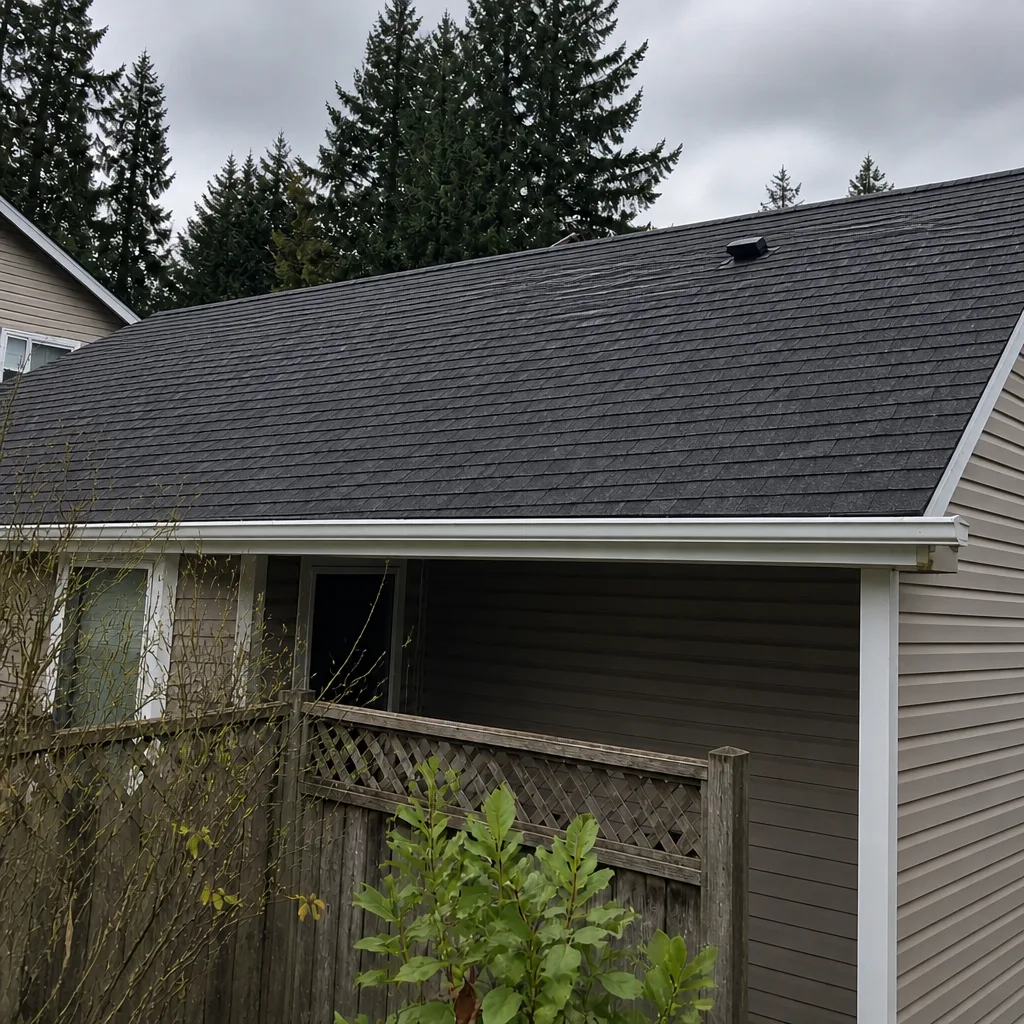
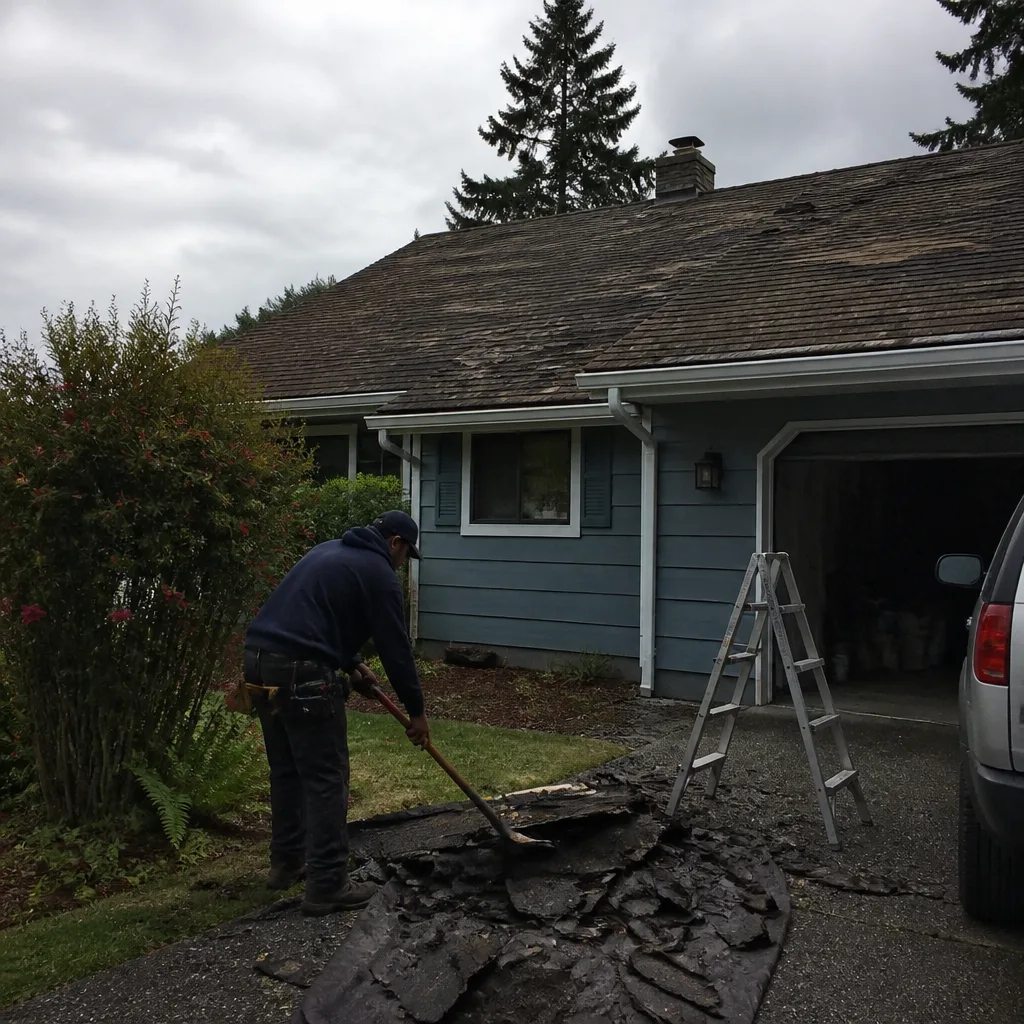
See the difference
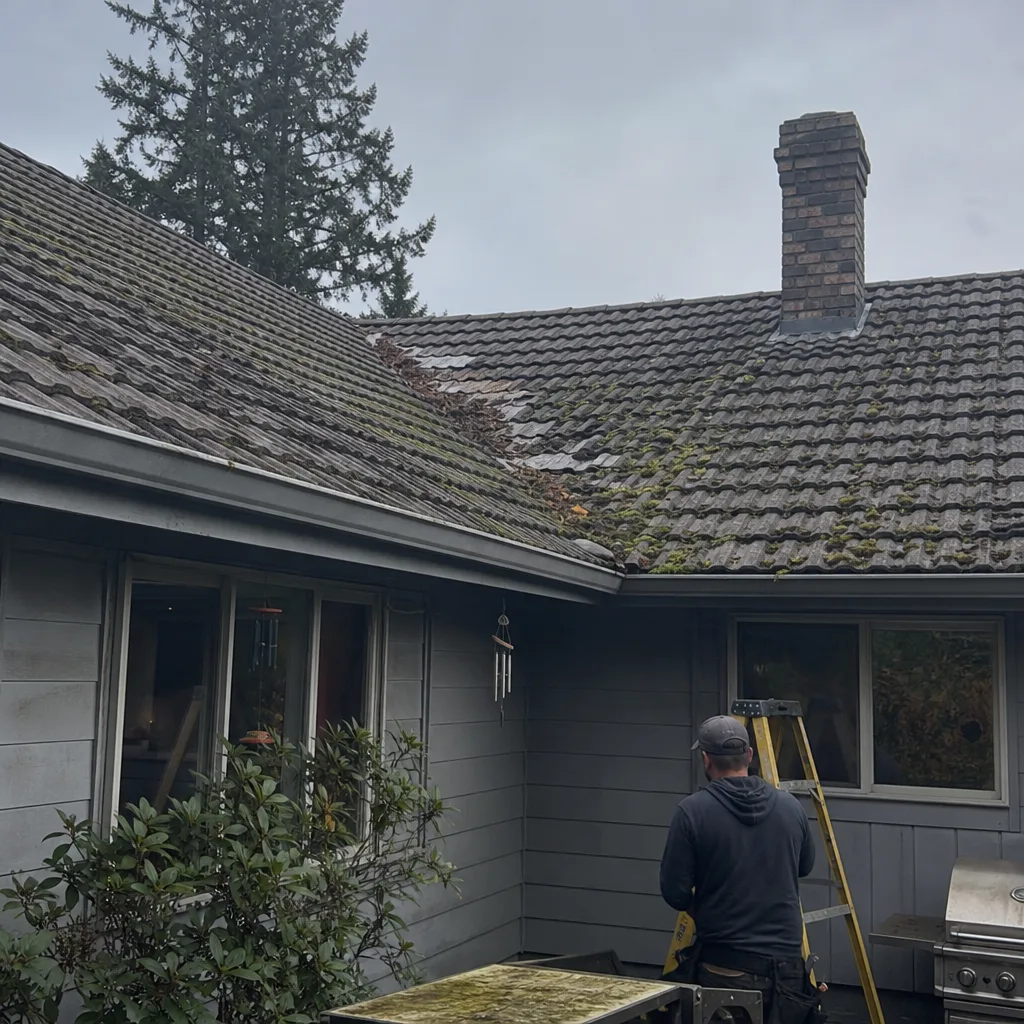 Before
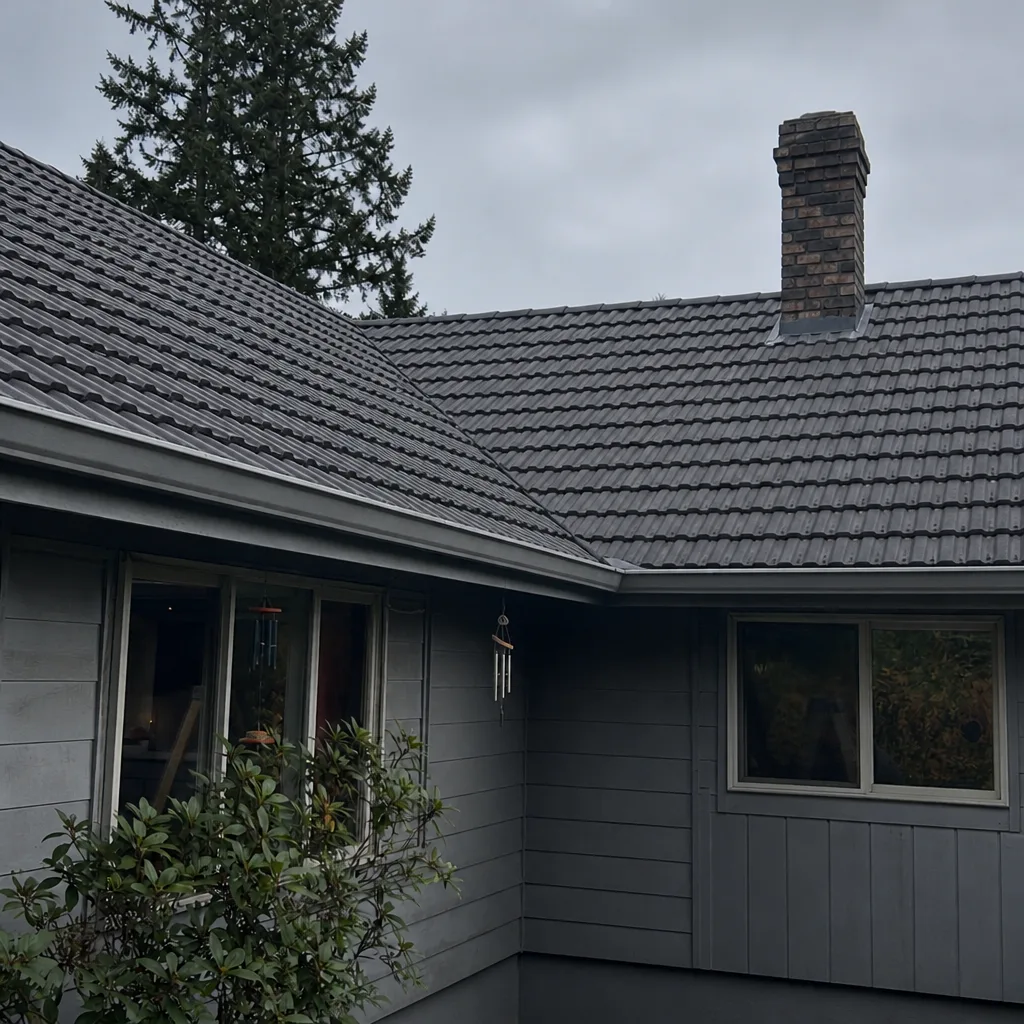 After
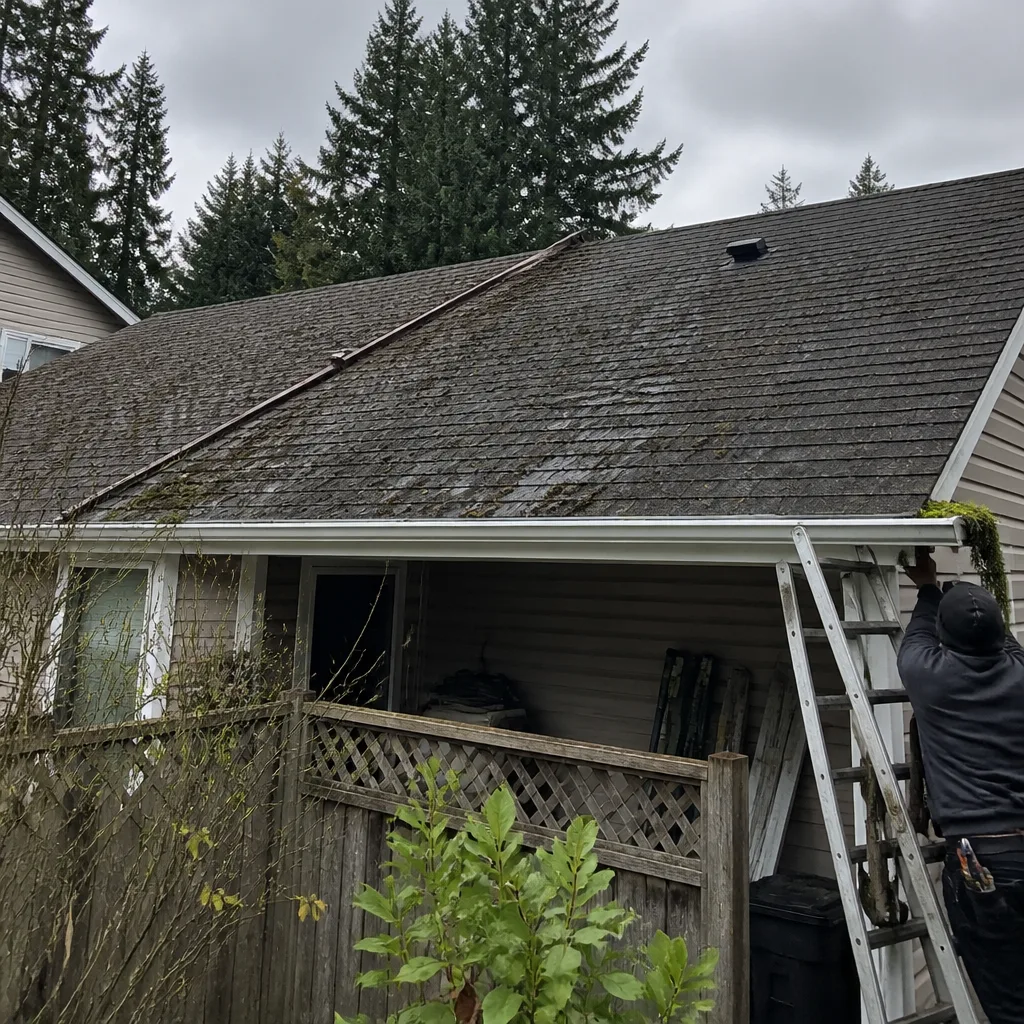 Before
 After
 Before
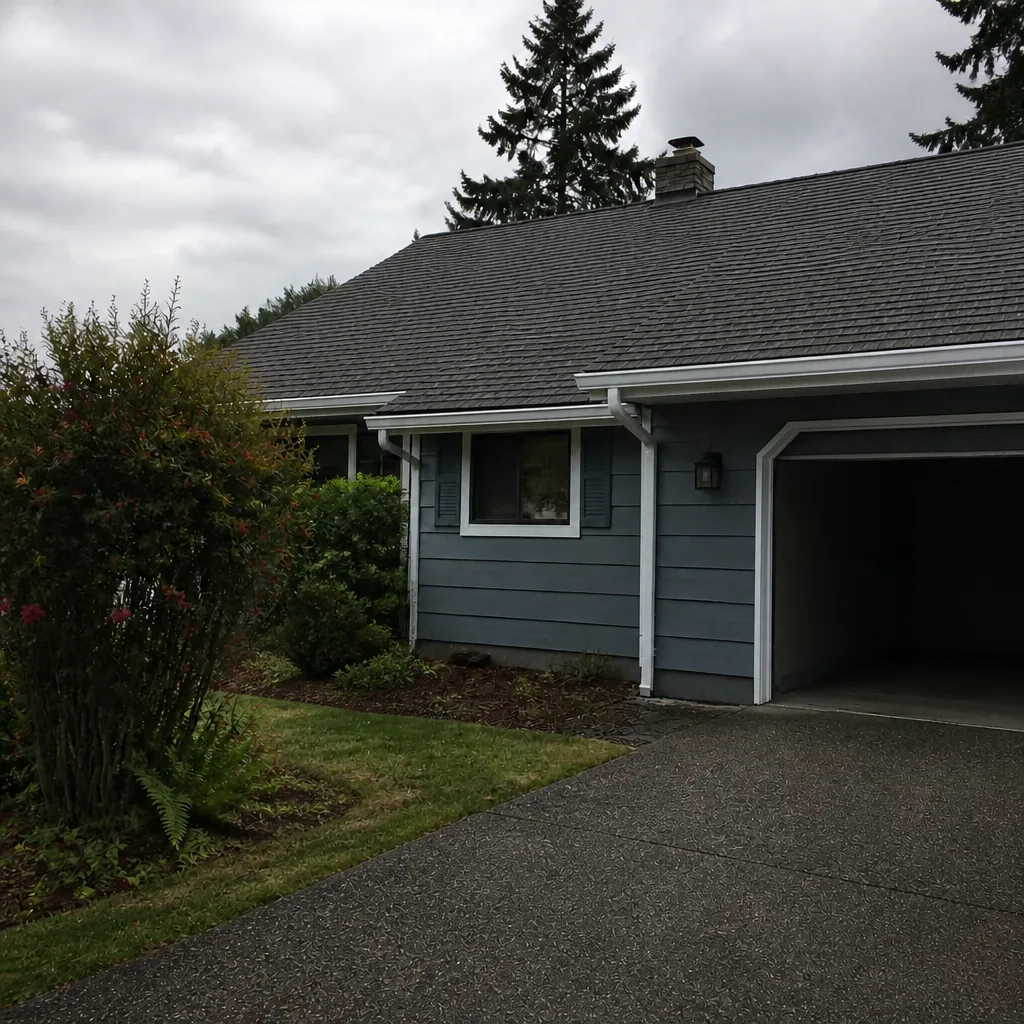 After
When to Call a Professional
Call when you see any Tier 1 sign, when Tier 2 signs are stacking up, or when a repair keeps failing in the same place. Also call when you’re not sure: a professional inspection is a small cost compared to what a missed warning sign turns into, and a free estimate at least gives you a clear picture. If you’ve just bought a home in Everett with an aging roof, or you’re prepping to sell and want a documented condition report, that’s a good reason to call too. We can work with your insurer if a claim is part of the picture. Roofing Everett offers free estimates in Everett. Call (425) 382-8630. We answer 24/7. Fast dispatch from 7am to 7pm, Sunday through Friday.
Frequently Asked Questions
The most common are moss and lichen growth, granule accumulation below downspouts, cracked flashing sealant, rust streaks below vents and chimneys, and staining on attic sheathing or rafters. Cupped or curling shingles and attic condensation round out the list. Any one of them is worth an inspection; two or more together usually point to a roof nearing replacement.
Repair is usually right when the problem is localized, such as one flashing joint or a single valley. Replacement is usually right when granule loss is structural across multiple slopes, when curling appears in more than one area, or when attic staining is active and broad. The number of failing systems matters more than any single sign. Call (425) 382-8630 for a free estimate that’ll give you a clear read either way.
Both. Moss holds moisture against the shingle surface, which accelerates granule loss and shortens the shingle’s life. But the extent of moss growth is also a diagnostic signal: heavy, continuous moss across multiple slopes generally means the shingle surface is well into its wear cycle. Cleaning moss is worthwhile for the roof’s health, but the more useful question is what the shingle surface underneath looks like.
Yes, and in many cases that’s the better approach. Binoculars from the yard let you see curling, missing shingles, and granule wear. A phone camera on a selfie stick gets a close look without a ladder. Attic checks with a flashlight cover most of the interior signs. Avoid walking the roof, especially after rain or when the roof has visible damage. For anything beyond a ground-level check, call a licensed roofer.
Yes. The long wet season and cool shoulder months keep roofs damp for more of the year than in drier climates, which favors moss growth, flashing sealant failure, and moisture in the attic. Condensation problems are also more common because the temperature swings between wet and dry periods promote moisture movement. The signs covered in this guide are weighted toward what actually shows up here, not a generic national list.
For an asphalt shingle roof on a typical home, most replacements are a matter of days, with the exact timeline depending on the roof’s size, complexity, and how much decking needs repair. Tile and metal installations take longer because of the different installation method. We’ll give you a written timeline with the estimate, so you know what to plan for. Call (425) 382-8630 to schedule your free estimate.
The Bottom Line
Roof failure in Everett is almost always a slow sequence, and the signs along the way are there to be read. Moss tells you about shingle wear. Attic staining tells you about deck moisture. Flashing sealant cracks, rust streaks, and granule loss each mark a stage. The useful habit isn’t watching for one dramatic failure. It’s tracking the signs by urgency, inspecting the attic, running the downspout test twice a year, and calling for a free estimate when the pattern is clear. Roofing Everett installs asphalt shingle, tile, and metal systems from GAF, CertainTeed, Owens Corning, IKO, Atlas, Tamko, and Boral, which means the conversation about what goes up next starts with your material, not ours. When warning signs are stacking up, get a professional read before the next wet season.
Call (425) 382-8630 for a free estimate. We answer 24/7. Fast dispatch from 7am to 7pm, Sunday through Friday.
Written by the team at Roofing Everett.