
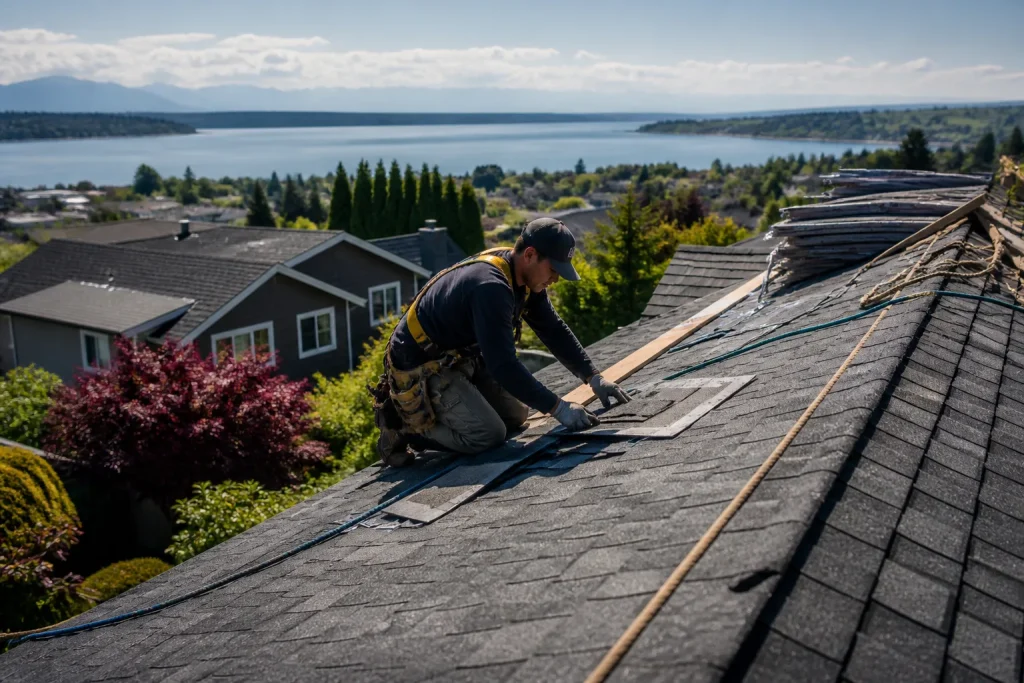
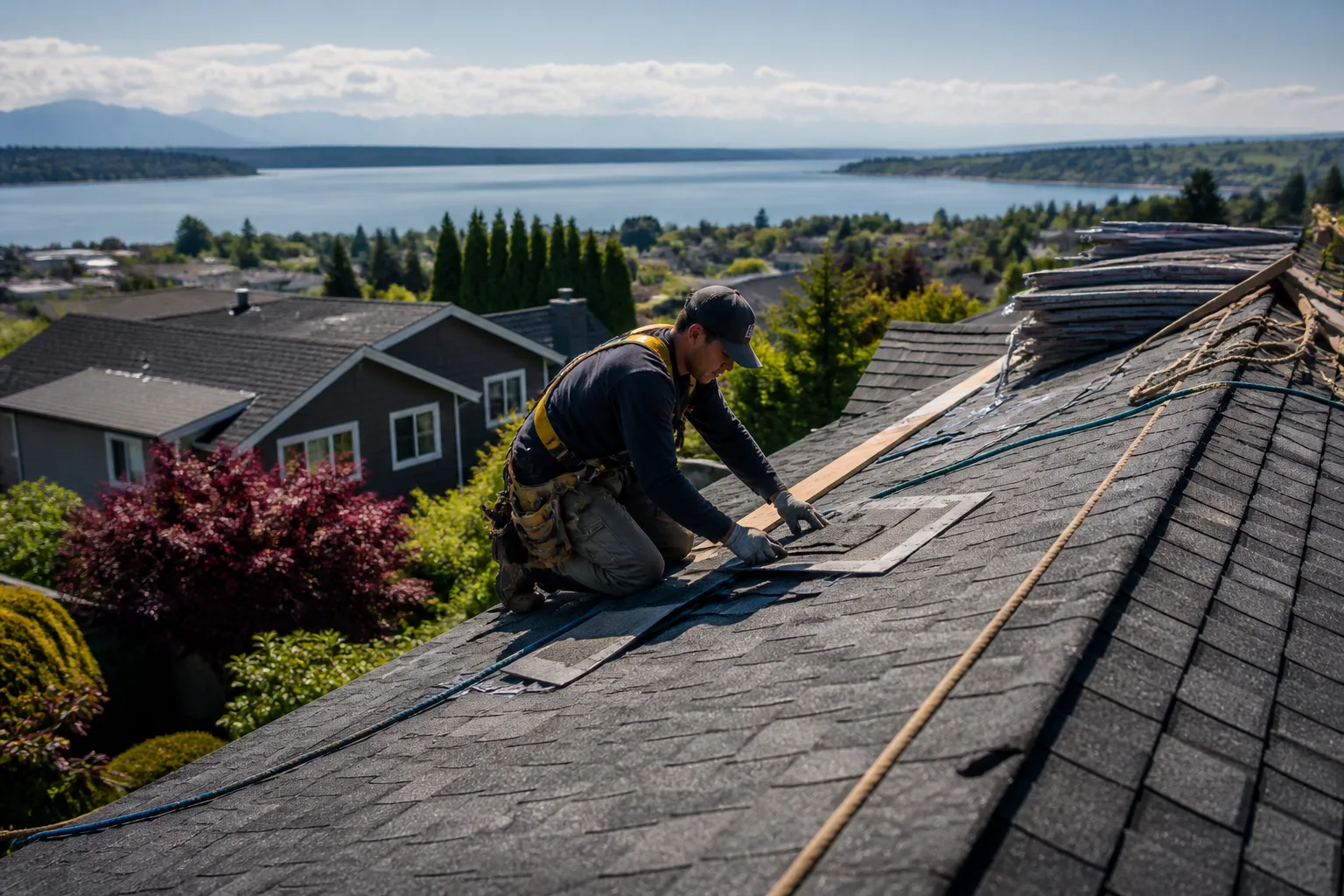
Roof Replacement Near Me: How to Choose a Local Roofing Company in Everett
Search “roof replacement near me” in Everett and you’ll get a map full of pins. The problem is that the pins don’t tell you who actually lives here, who’s licensed, and who’ll still answer the phone two winters from now. Most homeowners vet roofers by reading reviews and taking the lowest bid. After a wind event in Snohomish County, that’s exactly backwards. Here’s a checklist built around what actually predicts installation quality in Western Washington.
If you’d rather have a roofer walk you through it than sort through bids alone, call (425) 382-8630 for a free estimate. We answer 24/7, and fast dispatch runs 7am to 7pm, Sunday through Friday.
Why does the list of roofers in Everett grow after a wind event?
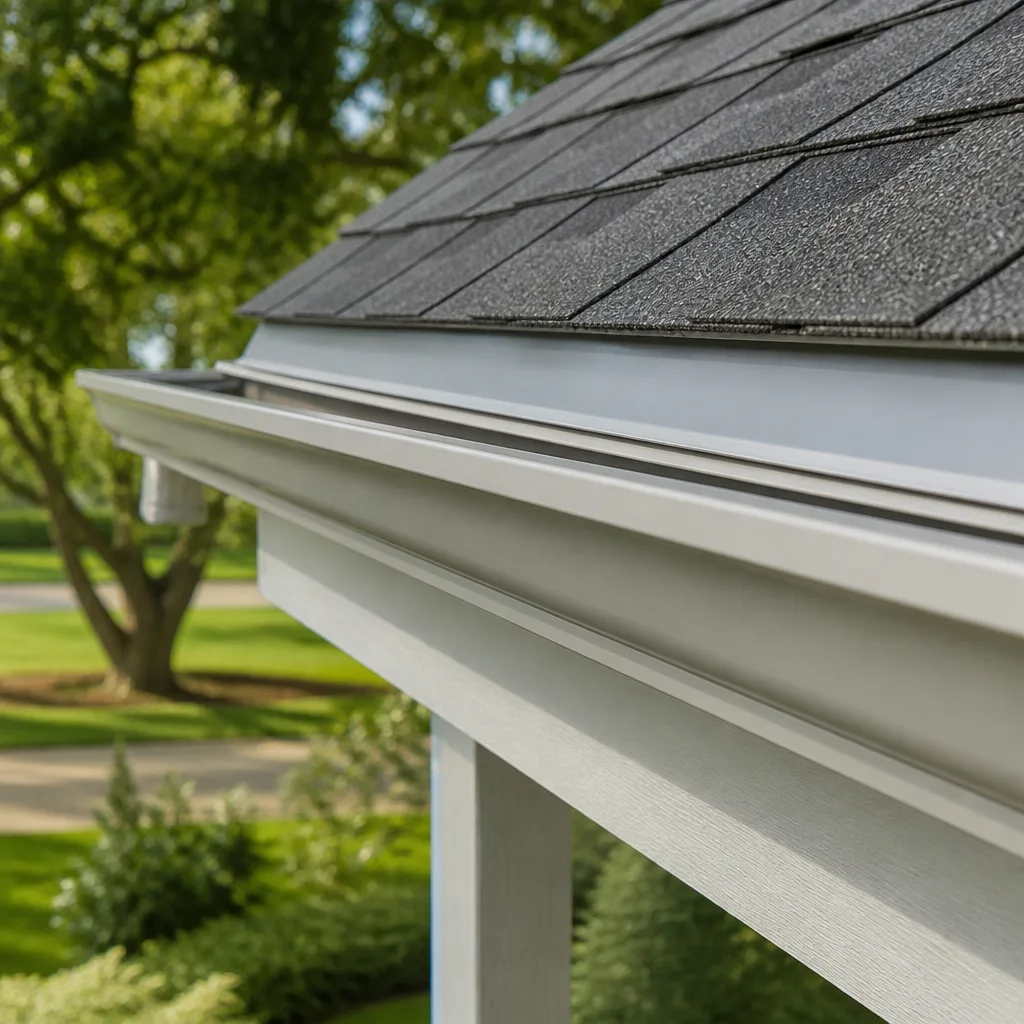
After a windstorm rolls through the Puget Sound lowlands, the number of roofing companies showing up on Google Maps in Everett triples within about 48 hours. Most of those additions aren’t local. They’re out-of-state crews following the insurance claim trail, and they’ll be gone before your first winter leak shows up.
This is the storm-chaser pattern, and Snohomish County sees it every time a gust front drops branches on shingles. The tell isn’t a single red flag. It’s the combination:
- Door-to-door within days of a storm. A local roofer who’s already booked doesn’t need to knock. Storm chasers do, because they have to close fast before they leave town.
- A bid with no line items. One number on a page, no material breakdown, no labor breakdown, no mention of underlayment or flashing.
- “We’ll handle your insurance.” No reputable roofer promises to run your claim for you. We can work with your insurer, but you’re the policyholder.
- Pressure to sign today. “This price is only good until we leave the neighborhood” is a sales tactic, not a scheduling constraint. The written estimate sets the price, and a legitimate one doesn’t expire by sundown.
- No physical address, or an address that turns out to be a mailbox store. Ask for it. Then check it.
None of this means every unfamiliar name is a bad actor. It means the vetting has to happen before the handshake, not after. And in Everett, where a wet fall can start in early October and not let up until spring, a roof installed by a crew that’s already left the state is a problem you inherit.
How do you verify a roofing contractor in Everett in under five minutes?
Washington splits contractor credentials into layers, and homeowners routinely confuse them. A general contractor license is not the same as a roofing-specific registration, and neither is the same as manufacturer certification. Three different things, three different checks.
- State contractor registration. Washington requires contractors to be registered with the state Department of Labor & Industries. Look up the company’s registration number on the L&I website before you let anyone on the roof. It takes about a minute and it tells you whether the registration is active and whether the company carries the required insurance and bond. The local pro we connect you with is licensed and insured as their state requires, and you should confirm it yourself the same way.
- Roofing-specific endorsement. A registration with a roofing specialty tells you the contractor is registered for roof work specifically, not just general construction. Ask which category they’re registered under, then check it yourself. A crew that’s registered for remodeling but shows up to tear off your shingles is a paperwork problem waiting to become a warranty problem.
- Manufacturer certification. This one lives on the manufacturer’s site, not the contractor’s. GAF, CertainTeed, Owens Corning, and IKO all publish their certified or authorized installer lists, and you can search by ZIP. If a bid says “certified installer” and the manufacturer’s locator doesn’t show the company, the logo on the truck is decoration.
Five minutes. Three tabs. If a company resists any of those checks, you have your answer, and it isn’t the one they wanted.
What does “manufacturer preferred contractor” status actually require?
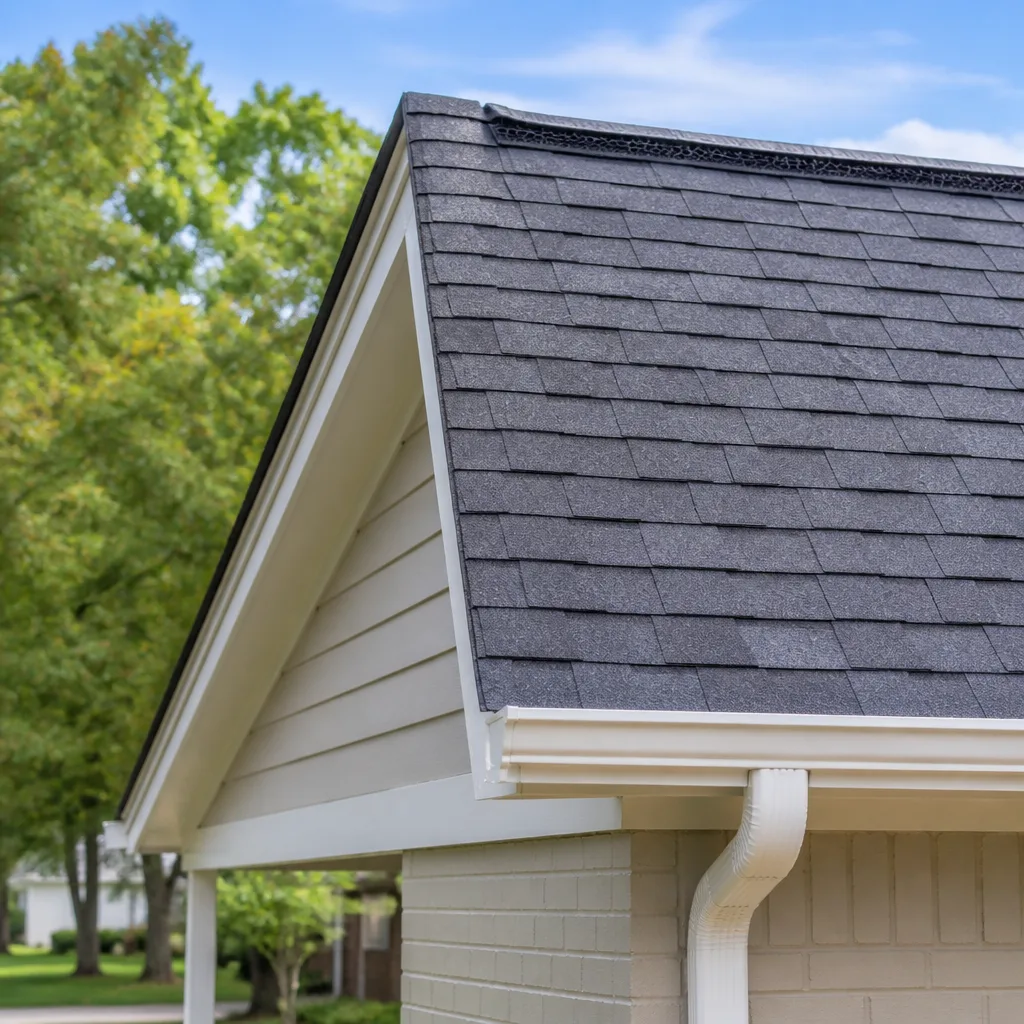
A logo on a truck means a company bought a decal. Manufacturer certification means the manufacturer has actually verified something, and the requirements are stricter than most homeowners realize. Depending on the program, certification typically involves a track record of installation volume, ongoing training on that manufacturer’s systems, and third-party inspections of finished roofs. Some programs require a warranty-backed workmanship guarantee and a clean record to stay in good standing.
That’s the difference worth paying attention to. When a manufacturer backs a warranty, the warranty is tied to certified installation. The shingles themselves carry a manufacturer warranty no matter who nails them down. The enhanced coverage, the labor and workmanship portion, usually doesn’t. It depends on the installer being certified and the installation being done to spec.
This is why we work across seven manufacturers, GAF, CertainTeed, Owens Corning, IKO, Atlas, Tamko, and Boral, rather than pushing whichever one pays the best spiff. The brand should follow your budget and your home, not the other way around. If a roofer only quotes one product and can’t tell you why that product beats the alternatives for your roof, you’re not getting advice. You’re getting inventory.
It’s also worth knowing that the two most common roofing certifications in Everett don’t cover the same material. Shingle certifications are everywhere. Tile and metal programs are far thinner on the ground. If you’re considering tile or metal, ask specifically whether the contractor is certified for that system, because a shingle certification tells you nothing about a standing seam panel.
Does a local address matter for roof replacement in Everett?
Yes, and not for the reason most people think. A local address matters because of what happens after the install, when a warranty question comes up and someone has to physically come look at the roof.
An Everett phone number that routes to a call center in another state is easy to buy. A physical office in Snohomish County is not. When a warranty issue arises in year four, the difference between those two shows up fast. One company can send someone out. The other routes you to a queue and starts a ticket.
Here’s how to tell them apart without being cynical about it:
- Call the number and ask where the company is physically located. A local operation answers the question plainly. A call center reads from a script.
- Ask who the warranty contact will be in three years. If the answer is “our corporate office,” find out where that is.
- Look for a business address you can drive past. You don’t need to visit. You just need the option.
This matters more in Everett than in a dry climate. Roofs here take a beating from wind-driven rain coming off the Puget Sound lowlands, plus moss pressure that doesn’t let up because the roof never fully dries between storms. A roof installed with proper underlayment, correct flashing at the valleys and penetrations, and adequate ventilation handles that. One installed with shortcuts develops problems slowly, over two or three seasons, which is exactly the window when a fly-by-night crew has already moved on to the next storm.
Whether you’re looking at a roof replacement on an aging home or a new roof installation on new construction, the warranty follow-through question is the same. Ask it before you sign.
Three questions to ask about subcontracting before you sign
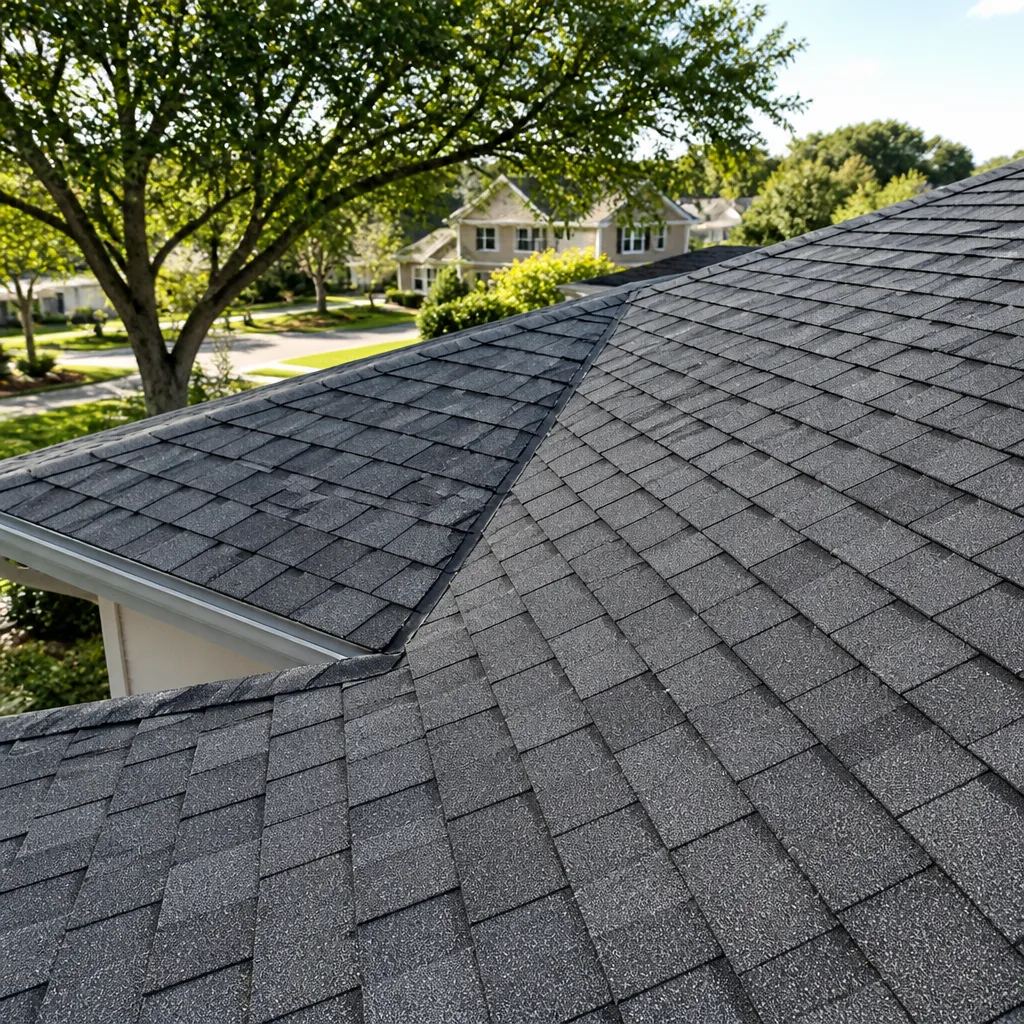
Subcontracting isn’t inherently bad. A lot of established roofing companies use sub crews, and some of those crews are excellent. The problem is that homeowners don’t ask, so they never find out who’s actually on the roof, who’s liable if something goes wrong, and who they call when a leak shows up. Ask these three questions and listen for straight answers.
Who is physically on the roof? If the answer is a subcontractor, ask whether the crew has worked with that company before and how long. A roofer who uses the same sub crews repeatedly has a relationship and quality control. A roofer who hires whoever’s available on a given week does not.
Who carries the liability? If a worker is injured on your property, or a load of shingles damages your gutter, whose insurance responds? The answer should be immediate and specific. If it isn’t, that’s the answer.
Who is the warranty contact? This is the one that matters most and gets asked least. Materials warranties run through the manufacturer. Workmanship warranties run through whoever installed the roof. If the company subcontracts, make sure the workmanship warranty is backed by the company you hired, not the crew they hired, because that crew may not exist in a year.
The material question is worth raising here too. If you’re weighing shingle versus tile versus metal, you’re not just choosing a look. Shingles are the lightest and most common option on Everett homes and the easiest to service. Tile lasts longer and holds up well against moss, but it’s heavier and the structure has to carry it, which sometimes means added framing. Metal sheds rain and lasts a long time, and standing seam panels handle the wet climate well, but it’s a different install skill set and costs more up front. Choose your material, not ours, and make sure whoever installs it is certified for that specific system. That’s the whole point of shingle roofing expertise versus tile versus metal, and a contractor who only does one of the three will steer you toward it every time.
We install asphalt shingle, tile, and metal systems, and our technicians have up to 8 years of experience. That breadth means you’re not vetting a separate specialist for a tile or metal project, and you’re not hearing one product pitched as the answer to every roof.
When should you call a pro instead of waiting?
Some roof issues are cosmetic and can wait. Others aren’t, and the difference isn’t always obvious from the ground. Call a professional if you’re seeing any of these:
- Granules collecting in your gutters or at the base of downspouts in noticeable amounts. That’s your shingles aging from the surface down.
- Ceiling stains, or bubbling paint on an interior wall near the roofline.
- Missing, lifted, or visibly damaged shingles after a wind event.
- Moss that’s spread across more than a small patch, or moss you’ve scraped back and found lifting shingle edges underneath.
- Sagging along the roofline, which can point to a structural issue that a new roof alone won’t fix.
We won’t hand you a step-by-step guide for walking a wet roof, because the roof is the one place where a fall is a genuinely serious problem and the damage isn’t worth the savings. What you can do safely from the ground is look, photograph, and call. The roof itself is a job for someone with the right fall protection and training.
If your roof is failing, or your home needs full roofing work in Everett, start with a free estimate. The estimate is free, the quote is written and line-itemed, and the price is set per job by that written estimate, so nothing changes once work starts. If a company won’t put it in writing, that tells you something.
Related services in Everett: roof replacement, new roof installation, and shingle roofing. If you’re weighing tile or metal, ask about those systems specifically when you call.
The Bottom Line
Choosing a roofer in Everett comes down to verification, not vibes. Check the state registration. Check the roofing endorsement. Check the manufacturer’s certified installer list. Ask about the local address and the warranty contact. And ask the three subcontracting questions before anyone climbs a ladder.
The lowest bid isn’t the best deal if the company is gone by next winter. The best bid is the one with line items, a real local footprint, and a warranty that someone will actually honor when rain finds a seam. Reviews tell you how a company performed for someone else. These checks tell you what will happen to your roof.
If you’re in Everett and need help sorting through it, Roofing Everett offers free estimates. Call (425) 382-8630. We answer 24/7. Fast dispatch from 7am to 7pm, Sunday through Friday.
Frequently Asked Questions
Look up the company’s registration on the Washington State Department of Labor & Industries website, confirm it’s registered for roofing specifically, and check the manufacturer’s online locator to confirm any certification the company claims. All three checks take about five minutes total and don’t require calling anyone.
A state registration is a legal credential that lets a contractor operate and shows they carry the required insurance and bond. Manufacturer certification is a separate credential from a shingle or panel maker, and it typically requires installation volume, training, and third-party inspections. A contractor can be legally registered and not certified by any manufacturer, which is why both checks matter.
The company you hired is responsible for the workmanship portion, and the manufacturer is responsible for the material warranty. That’s why the warranty contact question matters before you sign: you need to know the workmanship warranty is backed by the company on your contract, not by a subcontractor who may not be around later. The written estimate should spell out who covers what.
With a written line-item estimate and fixed pricing, it shouldn’t. The written estimate is what sets the final price. If a contractor discovers something under the shingles that changes the scope, like rotted decking, that should be documented and discussed with you before any additional work happens, not added to the bill afterward. Call (425) 382-8630 for an exact quote, and estimates are free.
Written by the team at Roofing Everett.
Need Roofing Help?
Call Roofing Everett - the local pro we connect you with is licensed and insured, here with fast help in Everett.
(425) 382-8630